


When we talk about inequalities in physical activity, we focus on the groups that Sport England research identifies as experiencing the greatest barriers to being active.
For adults, these include disabled people and those living with a long-term health condition, people aged 65 and over, lower socioeconomic groups, Asian, Black and Chinese adults, pregnant women and parents of children under one, and adults of Muslim faith.
For children and young people, the groups most affected include girls, children from less affluent households, Asian and Black children, secondary-school-aged young people who identify as a gender other than male or female, and those who lack access to parks, fields or outdoor sports spaces.
Sport England’s Inequalities Metric shows that these characteristics have the greatest impact on activity levels and therefore on opportunities to benefit from the physical, mental and social advantages that being active can bring.
But there is another factor becoming increasingly important: extreme heat.
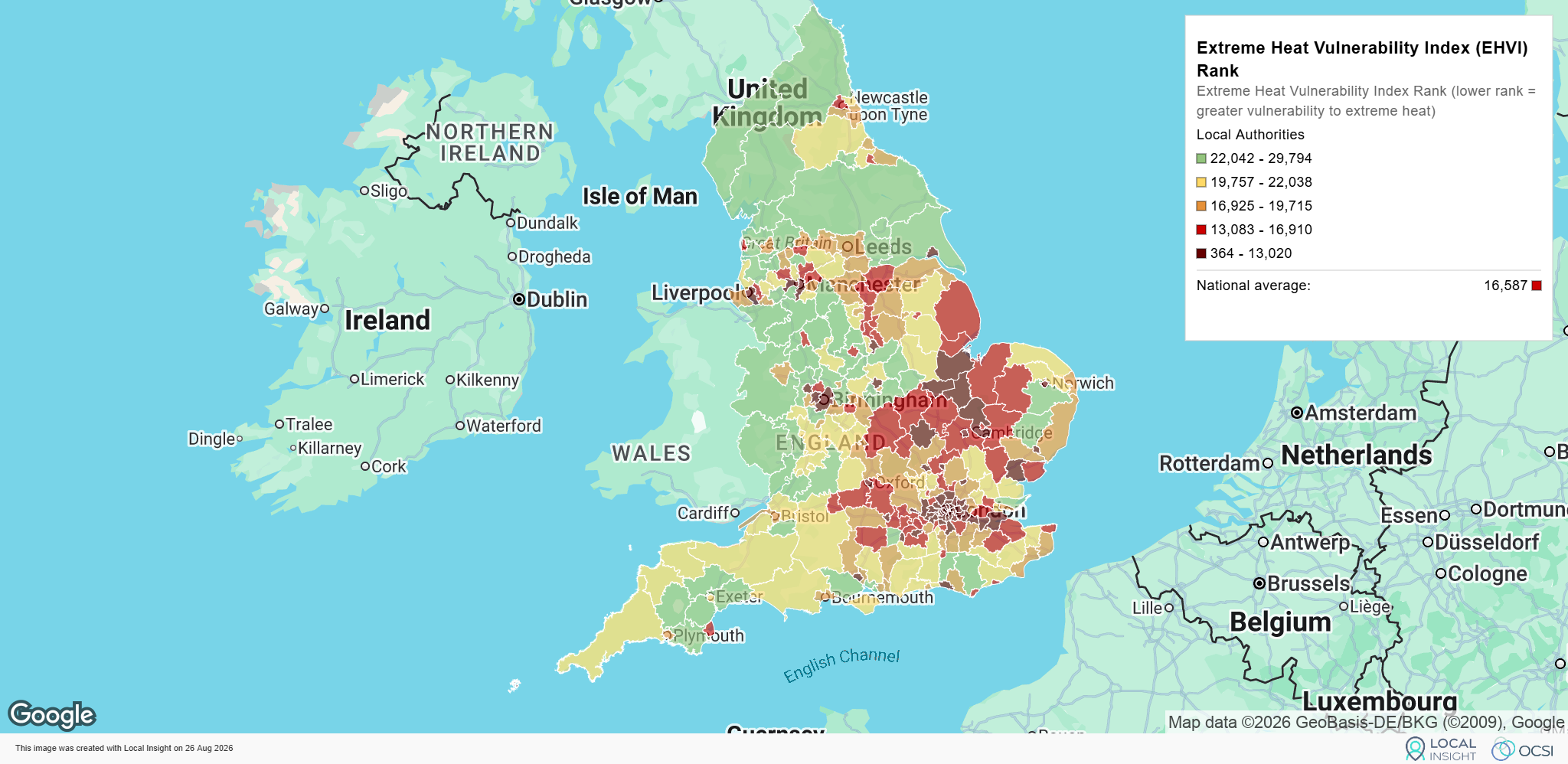
New data released by OCSI has mapped vulnerability to extreme heat across every neighbourhood in England, helping us understand which communities may find it hardest to cope as temperatures continue to rise. The findings suggest that many of the factors associated with lower activity levels may also be linked to increased vulnerability during periods of extreme heat. [ocsi.uk]
As physical activity organisations, local authorities, health partners and community groups continue to work together to tackle inactivity and inequality, this raises an important question:
How can we create places where people can stay active, healthy and connected in a warming climate?
Heat is not experienced equally
One of the most important findings from the new Extreme Heat Vulnerability Index (EHVI) is that vulnerability to heat is shaped by many of the same factors that influence health and wellbeing.
The index combines information on health conditions, housing quality, local environments, access to resources and people’s ability to prepare for and respond to heatwaves. [ocsi.uk]
Many of these factors are closely linked to the wider determinants of activity and wellbeing. People are more likely to face barriers to being active when they live with long-term health conditions, have lower incomes, experience poor housing, lack access to quality green space or face wider social and economic disadvantage.
The EHVI suggests that these same factors may also make it harder for communities to cope when temperatures rise.
In other words, the inequalities that shape physical activity participation also shape climate vulnerability.
What does the data tell us locally?
At a county level, Buckinghamshire appears relatively resilient, with an overall heat vulnerability score lower than the England average. However, as with many public health indicators, county-wide averages hide important local variation.
In Aylesbury South-West, one of the focus areas for Buckinghamshire’s Place Universal Offer, vulnerability is notably higher than the Buckinghamshire average. The data suggests residents may face greater challenges in preparing for and responding to periods of extreme heat.
The picture is even more striking in some of the Milton Keynes Place Expansion Partnership communities.
Eaglestone and Fishermead record an EHVI score of 151.0, while Stacey Bushes and Fullers Slade record a score of 164.2. Both are substantially higher than the England average and show elevated levels of vulnerability relating to residents’ ability to respond and adapt during heatwaves.
These findings align closely with what we already know about these communities. Existing insight from the place-based work highlights higher levels of deprivation, economic inactivity, health challenges, environmental barriers and reduced access to local amenities.
The new heat vulnerability data adds another layer to this picture, helping us understand how social, health and environmental inequalities interact.
Why should physical activity partners care?
Because many of the solutions overlap.
Physical activity is not simply about increasing participation in sport or exercise. It is about creating places where people can walk, wheel, cycle, play, socialise and connect with their communities.
Many of the features that support active lives can also help communities become more resilient to extreme heat.
Green spaces provide opportunities to be active while helping to cool urban areas.
Trees and natural shade make walking routes, parks and public spaces more comfortable during hot weather.
Active travel infrastructure supports healthier travel choices while reducing urban heat and air pollution pressures.
Community spaces and local networks can provide vital support for vulnerable residents during periods of extreme weather.
Strong social connections help communities respond more effectively to a range of challenges, from loneliness and poor mental health to climate-related risks.
This means investment in active communities can contribute to multiple outcomes at once: improving health, reducing inequalities, strengthening social connections and supporting climate resilience.
A new opportunity for place-based working
The new EHVI provides another valuable lens through which local partners can understand inequalities.
For too long conversations about physical activity, public health, climate adaptation, planning and community development happened separately. The reality is that they are increasingly connected.
The neighbourhoods facing the greatest challenges around inactivity are often the same neighbourhoods experiencing poorer health outcomes, lower incomes, environmental disadvantages and reduced resilience to climate impacts.
For Buckinghamshire and Milton Keynes, this presents an opportunity to think differently about how we design places and programmes.
Rather than viewing physical activity as a standalone agenda, we can see it as part of a wider system that helps communities thrive.
Looking ahead
The new heat vulnerability data reminds us that inequalities rarely exist in isolation.
Sport England’s Inequalities Metric identifies the groups least likely to benefit from physical activity, while the EHVI identifies communities that may struggle most during periods of extreme heat. Although they measure different things, both highlight the importance of addressing the social, environmental and economic conditions that shape people’s health and wellbeing. [ocsi.uk]
As temperatures continue to rise, creating environments that support physical activity may become even more important. Not just because active lives improve health and wellbeing, but because the places that help people be active are often the same places that help them be resilient.
For local authorities, health partners, community organisations and physical activity providers, the challenge is not simply responding to hotter weather. It is ensuring that every community has access to the spaces, opportunities, connections and support needed to stay active, healthy and resilient, whatever the future brings. [ocsi.uk]